Buccaneer Birds?

IMG_3284THE GREAT-TAILED GRACKLES OF GALVESTON

By Maria Adolphs

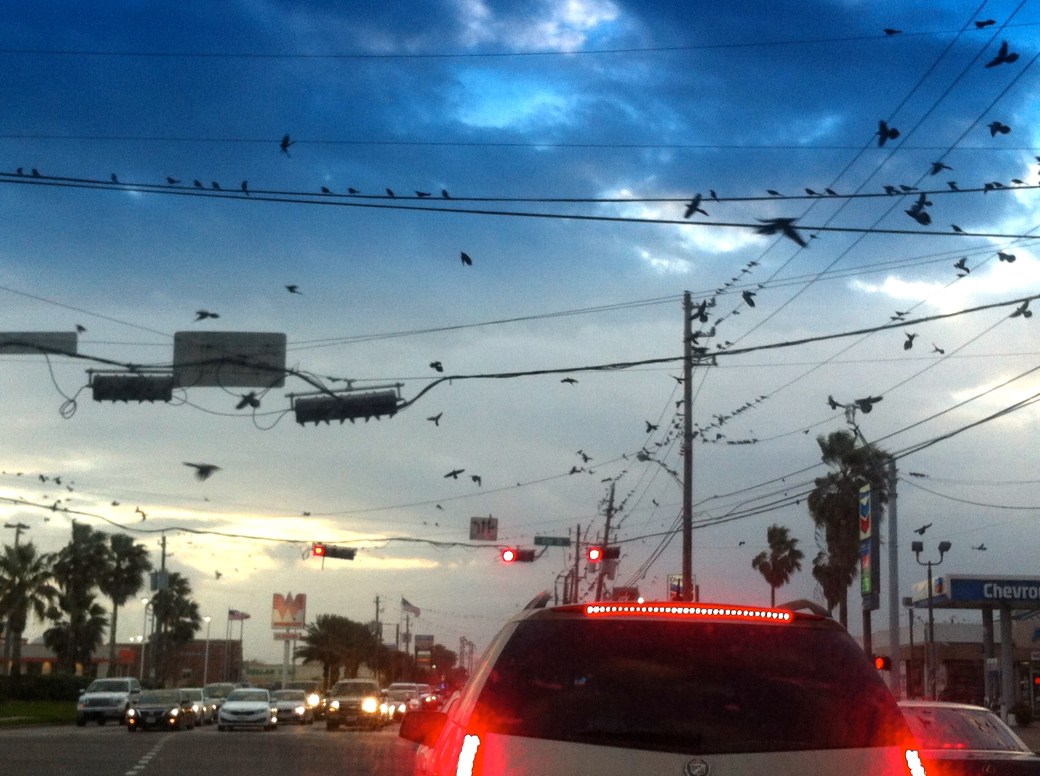
Maybe you have seen them too, flying in around dusk each day converging on the wires that crisscross 61st and S streets in Galveston, an island located on the Gulf Coast of Texas. You can definitely hear them—a raucous mix of screeches, clicking and whirring resembling sci-fi robots, car alarms, and power tools. I’ve seen them several times and have been amazed at the sheer number of birds and each time wondered what are they doing? Why are they gathering here? 

My husband, daughter and I had a few theories: Perhaps they are attracted to this spot because of a race memory— something hardwired in their DNA, their habitat destroyed long ago and where once stood ancient trees, now stand electrical wires and blinking lights. Or is it that the wires give off heat in the winter to warm them?  Or maybe, an even more ominous thought—they are plotting world domination and are monitoring our every move. I finally gave into my curiosity and consulted bird expert Jim Stevenson of The Galveston Ornithological Society, and he assures me it is none of those reasons. In a phone interview, Stevenson happily filled me in on what these birds are up to.

These birds are Great-tailed Grackles, not to be confused with the Boat-tailed Grackle, who prefer salt and freshwater marshes. Galveston is home mainly to the Great-tailed Grackle. You’ll notice two distinct sizes of Great-tailed Grackles up on the lines: the males are bigger and have iridescent black feathers and an oversized tail (hence the name) and the females are smaller and have feathers that are several shades of brown. There also may be a few Starlings mixed in as well.

Grackles? Wait a minute, are these the same birds that use my parked car as their blank canvas, creating Jackson Pollack-like works? These avifauna with attitude that boldly announce their presence?  The same birds that pillage and plunder my dog’s food, as she apprehensively obliges, the bullyragging birds that dive-bomb my garden finding the mother-load of booty for the taking?

The Great-tailed Grackles come to this intersection to roost. They prefer an urban setting because the light allows them to see nighttime predators, such as the Cooper’s Hawk. The flock will know to change location if a hawk starts picking them off, but usually, they stay in the same area. They begin to gather in the early afternoon, and as the skies darken, their numbers increase and their songs amplify. Although the sounds they make are peculiar and not particularly musical—a cacophony of chi-chi-chi’s, nee-no, nee-no’s, and wuppp-wuppps, Great-tailed Grackles are considered songbirds. The males can be seen gyrating their bodies, spreading their wings out and bending over emitting a call to attract females or to stake his territory. Finally settling in to sleep, from dusk to dawn, hundreds of Grackles occupy the wires. Upon first light, they shout, Show a leg! And are raring to go to a pet dish or bird feeder near you.

 Great-tailed grackles originally came from Central America and had spread as far north as Kansas, where open cultivated fields abound. They traveled up the Texas coast from the South and are now considered permanent residents of Galveston. Just as pirates established colonies on Galveston long ago, so too did the Great-tailed Grackles, claiming the island as their own. They are omnivores and have an undiscriminating palate, from french fries, discarded bait to pet food and insects. They often are found eating from bird feeders meant to attract more “desirable” birds, and they can’t resist a newly seeded lawn, which provides all the nutrients they need.

These activities often give them their “bad boy” (and girl) reputation. They are “borderline” nuisance birds as compared to pigeons, house sparrows, and starlings because they are considered more of a native bird now. The Common Grackle, found in central and eastern United States, however, cause more problems, as they have learned to eat the eggs of birds and baby birds. In time the Great-tailed Grackles may learn to as well.

The aggregation of Great-tailed Grackles on 61st and S and other parts of the island is impressive, often turning the skies black as they make their approach to their spots on the wires and streetlights. Agricultural fields and human activity have allowed their population to proliferate, without the benefit of being preyed upon by various predators. Although the Great-tailed Grackle population was significantly diminished after Hurricane Ike, it did not take long to repopulate. Like their hardy human counterparts, and other fauna whose habitats were decimated, who quickly pushed aside the mountains of wreckage, and began again.

I asked Stevenson if there is concern that human activity is disrupting habitats for the many different species of birds that call Galveston home. He said that the vast majority of birds are protected by state and federal laws. “The government sees the birds as being here first—a rather enlightened way to look at it,” says Stevenson. “We are also very fortunate here on Galveston Island to have many good areas set aside for birds and bird-watchers.”

I never gave bird-watching much thought until I talked with Stevenson, in fact, I thought it was an activity to do when you retire. But I must admit, I find myself looking up more often, scanning the skies with attentive ears, more aware of my surroundings, noticing every bird that happens my way, and I can now see the attraction. Sometimes it just takes a question to change your perspective.
A Wolf Among the Fold

mjaas0029

My daughter was bullied. Not by the stereotypical troubled thugs that lay wait to steal your lunch money, or stuff you into your locker, or dangle you inches off the ground like a marionette by your underwear. Not by a cruel clique of perfectly coifed girls whose favorite hobby is exclusion, or by the cyber-bullies that perform their degradation from behind a digital veil. No, it wasn’t that kind of tormentor. It was her teacher.

It was subtle at first. Little jabs and offhand utterances by the teacher about my daughter’s art skills—aren’t you going to fix that? Oh, you’re leaving it that way? Loud whispers to her classmates not to do their art as she does. Low grades on projects, that when compared to her counterpart’s “A” level work, portray no contrast in effort or product.

I know what you’re thinking, I must be one of those moms. A helicopter mom, hovering over her child, ready to swoop in at any sign of distress, shielding her from life experiences. The thing is, I’m not. Although she knows I am here for her, I’m the first to tell my kid to find a way to deal with life’s difficulties—and she always has— until now.

After those initial incidents, I told her to try and stay under this new teacher’s radar, not make waves and remain respectful and it would resolve itself. But it didn’t.

Picking her up from school one day my usually upbeat eighth-grader got in the car, despondent. She called me ugly, mom, in front of the whole class. Stunned, I drove away, listening as she recounted how another student and friend had been playing with my daughter’s hair and was questioned by the teacher what she was doing. The other student answered that she was trying to make her hair weird. In which the teacher responded, You can’t do much to make her uglier than she already is.

I can understand if there was an issue with behavior that a teacher should most certainly respond and correct, but in a way that is respectful and addresses a problem, not as a degrading comment on someone’s physical appearance—an adolescent’s physical appearance no less. And I understand teachers can have a difficult job, which often goes unappreciated, and is rewarded with little pay. I also know that people sometimes say things that are hurtful or regretful in the heat of a moment. Even adults. I have. But I also know that when we do, we should admit our mistakes, apologize, and strive not to do it again.

Instead, the teacher said she was joking, then later denied saying it at all, despite a roomful of classmates as witnesses. She even failed to attend a meeting to discuss the incident. The principal offered no consolation either, by dismissing the student’s accounts as unreliable, if she even heard them at all.

The principal refused our requests to remove my daughter from the class, worried that other parents would follow suit (which they did), and after monitoring one class, in which the teacher was of course, on her best behavior, deemed there were no concerns. Instead, chalking the problem up to a disrespectful class. I recognize that a class of 8th graders could get rowdy, but when no issues with behavior were ever noted, I find it suspect.

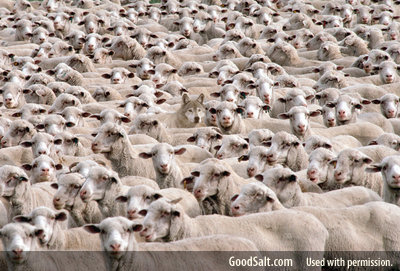
We need to look under the school’s rather dusty rug. We need to be aware of a Wolf among the fold.

I could go on and on about my kid’s exemplary career as an honor student at this private, parochial school she’s attended since pre-kindergarten. How she sings in the church choir since she was four, or that for years this class has a record of excellence both in academics and behavior, but the point of the matter is that no child should be degraded. No teacher or leader should abuse their position of power to make a child feel small. No person should be silenced when they see injustice.

We cleaned out her locker, returned her books and said goodbye to the many excellent teachers and staff that have known her almost her entire life; who have had a positive impact on her life. With teary eyes, they expressed their shock that the situation had come to this and assured my daughter that she would do well wherever she goes. And she will.

I am so proud of my daughter for telling me, despite the unknown repercussions, and I am very proud and grateful to the students that stepped forward, even though their account fell on deaf ears. I hope they will always listen and speak out when their gut is telling them something’s not right.

For some students, however, the fear to speak up is insurmountable. When an adult crosses the line, especially an authority figure, children often don’t know what to do. In the article Abuse of Power, Adam McEvoy, Professor of Sociology at Northern Michigan University writes, “When students are targeted by teachers, they often feel shamed and powerless…Teacher bullying can also have a contagion effect, indicating to students that the bullying of a particular individual is acceptable and making the individual vulnerable to more abuse.” Often too, whether the student is a target or witness, they will remain silent for fear of retribution.

McEvoy also says that bullying by adults in a school setting persists because although other teachers or staff may know, or have suspicions of the offending adult, they don’t know what to do either, especially if there is no support from school officials. While there may be policies in place for student to student bullying, often there is no such procedure relating to bullying by an adult.

After repeated attempts to find a resolution with the teacher and administration—whose ultimate job is to create a safe, nurturing environment for learning—I can understand the powerlessness my child felt. We fought back the only way we could by leaving the school, and not paying for my kid to be intimidated; hitting them in the wallet, instead. Perhaps the adage to “just walk away” when dealing with bullies is fitting. But others may not have that option, and the need to identify teacher bullying as reality is imperative.

Bullying by a teacher or principal is often an unreported problem. Jessica Kelmon in an article on greatschools.org writes:

Amid mounting data that bullying is on the rise, there’s a glaring absence of statistics on adult school bullies. In part, perhaps, because bullying by a teacher or principal is far more complex to identify, address, and rectify. It’s difficult to know what to make of a teacher who crosses the line from basic discipline to regularly berating, intimidating, humiliating (and even physically abusing) a student — so much so that a child’s afraid to be in school.

The effects of not addressing adult school bullies can have lasting, damaging results: for the school’s reputation and enrollment, for the many “good” teacher’s standing and ability to gain trust and respect, but most importantly for the well-being of the child.

I lost much sleep debating whether removing her from this school was the right thing to do and ultimately we decided as a family it was. The message she received that it’s okay to demean and hurt someone, not take responsibility, and obscure the truth, is not a message we can accept, nor a way we want to live our lives.

Both McEvoy and Kelmon offer excellent advice in dealing with this problem, that is all too often swept under the rug. If you suspect your child, or a child you know, is experiencing adult bullying I encourage you to read these articles. Be the advocate a child sometimes needs.

***


Works Cited:

Kelmon, Jessica. “When the Teacher Is the Bully.” Parenting. Greatschools.org, 8 Feb. 2016. Web. 01 May 2017. http://www.greatschools.org/gk/articles/when-the-teacher-is-the-bully/.

McEvoy, Alan. “Abuse of Power.” Teaching Tolerance. Tolerance.org, Fall 2014. Web. 1 May 2017. http://www.tolerance.org/magazine/number-48-fall-2014/abuse-of-power